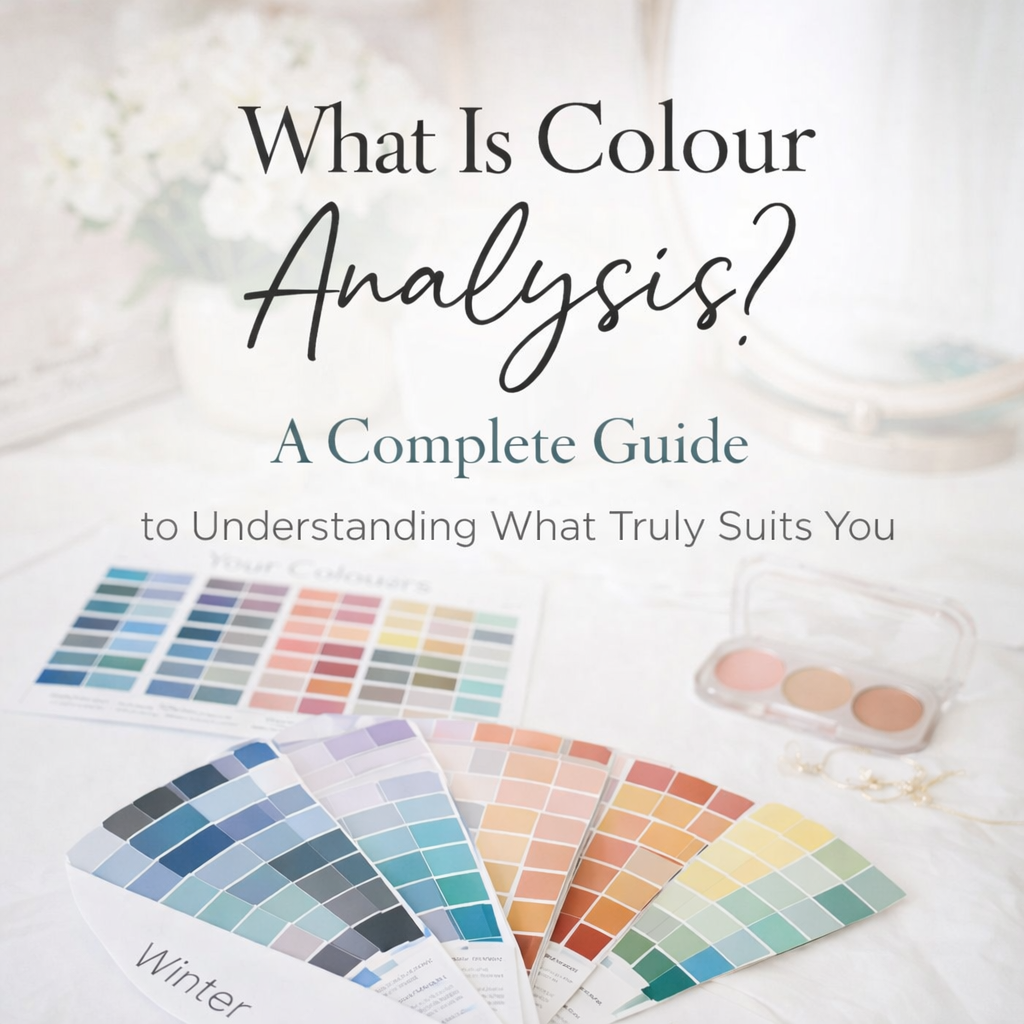
If you’ve ever stood in front of your wardrobe and felt that, despite having plenty of clothes, nothing quite works together, you’re not alone.
Very often, this isn’t about having the wrong clothes. It’s about wearing colours that don’t naturally harmonise with you.
This is where colour analysis comes in.
What Is Colour Analysis?
Colour analysis is a process used to determine which colours naturally suit your unique colouring – your skin tone, hair and eyes – and enhance your overall appearance.
At its core, it’s about harmony.
When the colours you wear reflect your natural colouring:
- Your skin appears brighter and more even
- Your eyes look clearer
- You appear more rested and put together
Rather than the clothes being the focus, you become the focus.
The Foundations: How Colour Analysis Works
Modern colour analysis is based on three key elements:
- Undertone (warm or cool)
- Depth (light to deep)
- Clarity (soft/muted to bright/clear)
These elements combine to place you within a seasonal palette, such as Spring, Summer, Autumn or Winter, often refined further into the 12 season system for greater accuracy.
Each palette reflects a specific balance of these characteristics, helping to guide the colours that will feel most natural on you.
The Four Seasons of Colour Analysis
At the heart of colour analysis is the concept of the four seasons: Spring, Summer, Autumn and Winter.
Each season reflects a distinct combination of undertone, depth and clarity — and understanding these can provide a helpful starting point when exploring your colours.
Winter (Cool, Deep, Clear)
Winter palettes are cool-toned with a higher level of contrast. Colours are typically bold, crisp and clear.
Think:
- Black and white contrasts
- Jewel tones such as emerald, sapphire and ruby
- Icy, cool shades
Winter colouring tends to be enhanced by strong, defined colours, while softer or overly warm tones can feel less harmonious.
Summer (Cool, Soft, Light–Medium)
Summer is also cool-toned, but much softer and more muted than Winter.
Think:
- Dusty pinks and soft blues
- Cool greys and gentle lavenders
- Blended, understated tones
These colours create a soft, elegant and harmonious effect, rather than high contrast.
Autumn (Warm, Rich, Muted)
Autumn palettes are warm, with depth and richness, but a more muted quality.
Think:
- Terracotta, rust and burnt orange
- Olive green and warm browns
- Golden, earthy tones
Autumn colouring is enhanced by warm, grounded shades that feel natural and rich, rather than bright or cool.
Spring (Warm, Light–Clear)
Spring is warm like Autumn, but lighter, brighter and more vibrant.
Think:
- Fresh corals and peach tones
- Light, warm greens
- Clear, sunny colours
Spring palettes bring a fresh, radiant quality, with colours that feel light, lively and full of warmth.
A Starting Point — Not the Final Answer
While the four seasons provide a useful overview, most people sit more precisely within the 12 season system, which refines these categories further.
It’s also important to remember that features such as hair colour or eye colour alone don’t determine your season. What matters most is how your skin responds to colour, something that is best assessed through careful observation and, ideally, professional draping.
The 12 Season System (A More Refined Approach)

You may have heard of the four seasons in colour analysis — Spring, Summer, Autumn and Winter.
The 12 season system takes this a step further, offering a more personalised result by refining each season into subcategories such as:
- True/Soft/Deep Autumn
- True/Soft/Light Summer
- True/Light/Bright Spring
- True/Deep/Bright Winter
This allows for a much more tailored palette, rather than a one-size-fits-all approach.
Why Colour Analysis Makes Such a Difference
Understanding your colours isn’t about rules, it’s about clarity.
When your wardrobe aligns with your palette:
- Getting dressed becomes easier
- Clothes mix and match more naturally
- Shopping becomes more intentional
- You feel more confident in what you wear
Many people find they already own pieces that suit them, they just don’t yet know why they work.
Can You Do Colour Analysis Yourself?
It’s possible to begin exploring your colouring at home, and doing so can be a helpful starting point.
However, it’s also where many people become confused, as colour analysis is more complex than it first appears.
Here are a few gentle ways to begin exploring:
1. Try the Black and White Photo Test
Take a well-lit, makeup-free photo of yourself and convert it to black and white.
This helps you see your natural contrast level:
- Low contrast → softer, more blended colouring
- High contrast → more defined features
This can help guide whether softer or more defined colours may suit you.
2. Compare Warm vs Cool Colours

In natural light, try holding:
- A warm colour (e.g. orange or warm beige)
- A cool colour (e.g. magenta or cool grey)
Look for changes in your skin:
- Does it appear brighter or more uneven?
- Do shadows soften or deepen?
This can give an early indication of undertone.
3. Notice What You’re Drawn To (and What Works)
Often, people naturally gravitate towards colours that suit them, even if they can’t explain why.
Take note of:
- Compliments you receive
- Colours you feel most comfortable in
- Pieces you wear repeatedly
These patterns can be surprisingly revealing.
Why DIY Colour Analysis Has Its Limits
While these methods can be helpful, they’re not always conclusive.
Colour analysis is not just about what you see, it’s about how your skin subtly reacts to colour, which can be difficult to assess objectively.
Lighting, camera settings, makeup and especially personal bias can all affect the outcome.
As highlighted in colour theory and analysis frameworks, draping (observing how fabric interacts with the skin in controlled conditions) is the most reliable method.
The Value of a Professional Colour Analysis
Working with a trained colour analyst allows for a much more accurate and confident result.
During a professional session:
- Colours are tested systematically
- Lighting is controlled
- Subtle differences are observed in real time
- Your palette is refined step by step
This removes the guesswork and gives you a clear, personalised outcome.
Many clients say the most valuable part is not just being told their colours, but seeing the difference for themselves.
In-Person and Online Colour Analysis
If you’re local to Somerset, an in-person session allows you to experience the full draping process and see the effects of colour in real time.
If you’re not based nearby, online colour analysis offers a carefully guided alternative, using structured imagery and a considered process to achieve accurate results from wherever you are.
Both approaches are designed to give you clarity, confidence and a palette you can use every day.
A More Considered Way to Dress
Colour analysis isn’t about restricting your choices or replacing your wardrobe overnight.
It’s about understanding what works and building from there.
Over time, this leads to:
- A more cohesive wardrobe
- More confident outfit choices
- A simpler, more enjoyable approach to getting dressed
Discover Your Colours
If you’ve been curious about colour analysis, exploring it properly can be a valuable investment in your style and confidence.
I offer personalised colour analysis sessions, both in-person in Somerset and online, designed to help you discover the colours that truly suit you.
If you’d like to find out more, you’re very welcome to get in touch or explore the options on my website.
Remember:
You don’t need more clothes.
You simply need the right ones, in the right colours.
To find out more, contact Kate at thepersonalcolourcompany@gmail.com

Leave a Reply